

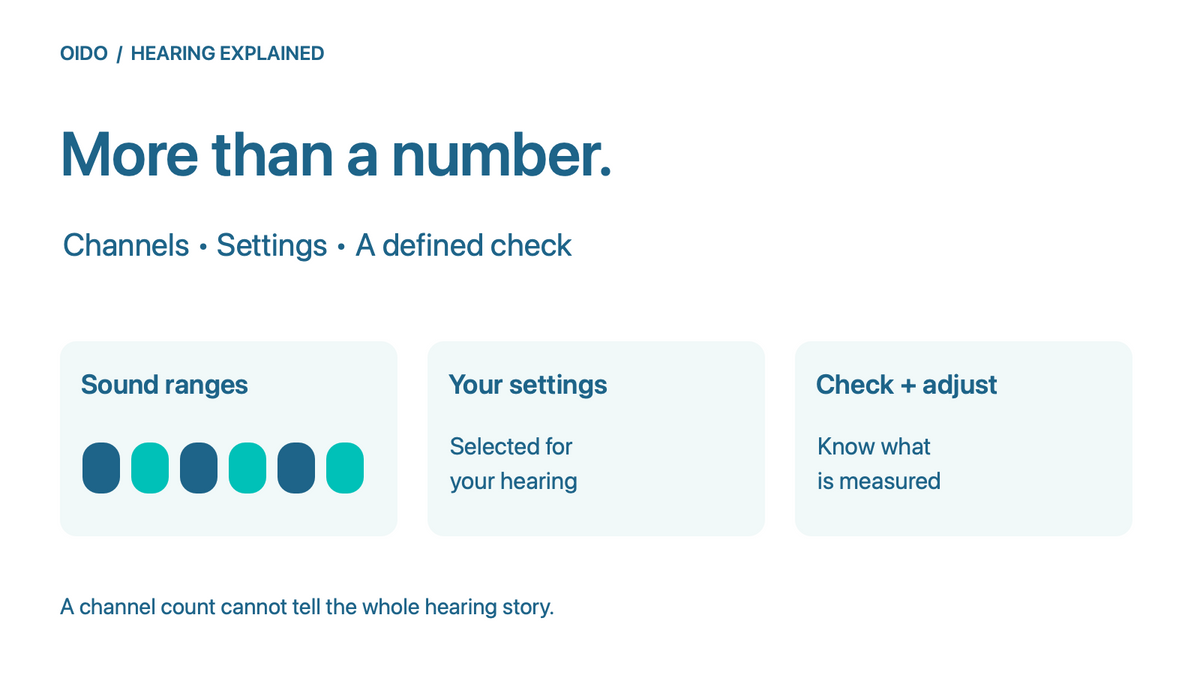
Eight channels. Four channels. What does that actually mean for your hearing? A channel count describes part of a hearing aid’s sound processing. It does not tell you, on its own, how well you will understand a conversation—or how comfortable the sound will feel.
When comparing affordable hearing aids, look at both what the device can adjust and how its settings are selected and checked. Here is how those pieces fit together.
Channels and bands, in everyday language
Sound includes low pitches, such as a deep voice, and high pitches, such as a whistle. Hearing aids can treat different ranges of pitch differently instead of turning everything up by the same amount.
- An adjustable frequency band is a range where amplification can be changed—rather like a bass or treble control, with finer divisions.
- A compression channel also controls how amplification changes as sounds get softer or louder within a range. Compression helps give soft sounds more help without increasing louder sounds by the same amount.
- “Processing channels” is a broader product term. Check what a manufacturer means before treating two advertised numbers as directly comparable.
Bands and compression channels are related, but they are not interchangeable specifications. A device can have separate controls for shaping its frequency response and for compression. Different designs also allow different amounts of interaction between ranges. [6]

What can extra channels do?
More independently adjustable ranges can offer finer control over the way amplification varies across pitches and sound levels. That can be useful when a person needs different amounts of help in neighboring ranges.
But more controls do not automatically produce more useful sound. Their effect depends on the processing design, the settings, the person’s hearing and the listening situation. A channel is not a separate voice detector: eight channels do not mean eight people can be separated from a noisy room.
Channel count also does not summarize every feature that matters. Microphones, noise processing, physical fit, controls and support deserve attention too. Advanced technology can be valuable; a single number simply cannot describe the whole experience.
Does research say four channels are enough?
No universal cutoff has been established by the studies reviewed here. Different experiments ask different questions, so their channel numbers need context.
- A 1995 study involving 16 listeners found average speech-in-noise improvements when compression channels increased from four to eight. It did not find a significant average improvement from eight to sixteen in that experiment. [2]
- A 2020 study with 20 adults tested simulated hearing aids with 3, 6, 12 or 22 compression channels. It found no statistically significant channel-count effect on sentence recognition in the tested background babble. Importantly, frequency-response shaping was handled separately, so this was not a comparison of every benefit that extra adjustment bands might provide. [3]
“Not statistically significant” does not mean “proved identical.” It means the study did not establish a difference using its test and statistical threshold. These results do not prove that four channels suit everyone, or that a particular eight-channel product will outperform a particular four-channel product.
Why the settings deserve attention
Having useful controls is one part of the job. Choosing appropriate settings is another. Here, fitting means selecting and adjusting the amplification for the wearer, alongside choosing a comfortable physical fit.
A small 2012 report illustrates the distinction. Five experienced users tried premium digital aids at their default fittings and an older analog aid fitted to a prescribed target. The analog aid could outperform some of the default digital fittings on a speech-in-noise test. When the digital aids were reprogrammed and checked against the prescription, results improved. [1]
That is a lesson about fitting—not proof that analog technology is better. The study was small, used older devices and did not isolate channel count.
Other research reinforces the need for nuance. A 22-person crossover study found greater self-reported communication benefit with a verified prescription than with the manufacturer’s initial fit. [4] But a newer trial of 45 first-time users found that more participants preferred the initial fitting, even though real-ear fitting brought the measured response closer to the target. [5] A measured target and a wearer’s preference answer different questions; both deserve attention.
Fitting and verification are different steps
Fitting chooses the settings. Verification checks a defined result. The important question is: what is being measured?
In professional real-ear measurement, a small probe microphone measures sound near the eardrum while the hearing aid is worn. The measured output can be compared with a prescribed target. That is an acoustic measurement—not a direct test of understanding every conversation.
OIDO’s documented patented method uses a different check. After initial personalization, the wearer keeps the hearing aids on while a separate, calibrated source presents test sounds. The wearer’s responses help identify which soft tones they can detect with the aids in place. Those responses can guide further adjustments, followed by another check.
This is an aided sound-detection check. It does not measure speech understanding in noise, establish normal hearing or replace a professional hearing evaluation. It is not the same measurement as a probe microphone at the eardrum. The studies discussed here did not test OIDO’s particular method and should not be read as proof of its clinical outcomes.
Explore OIDO’s patented technology or See how setup and verification work. Equipment and services vary; follow the instructions for your device and the supported setup. Read the science behind OIDO’s patented method.
What does this mean for HearOne versus HearDuo?
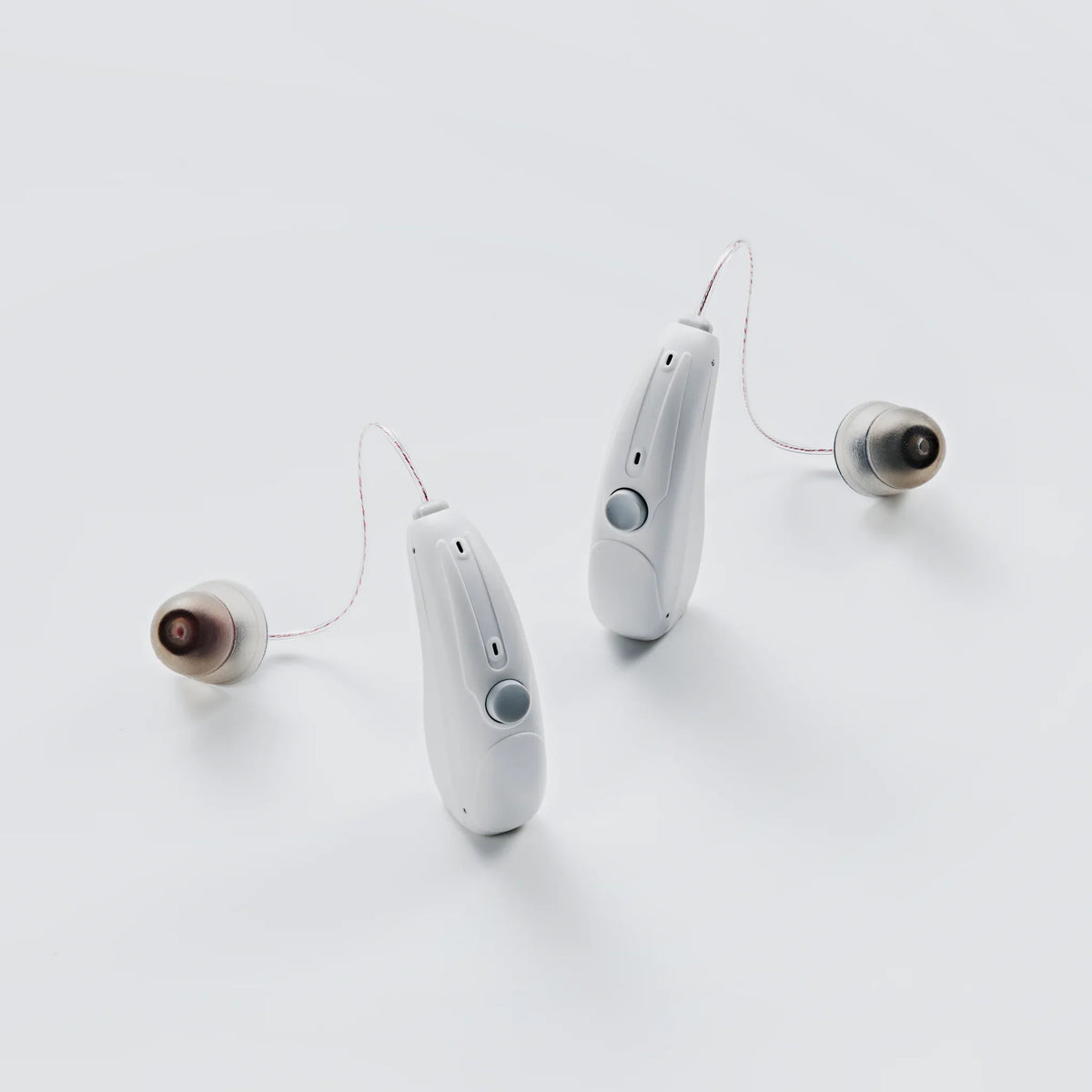
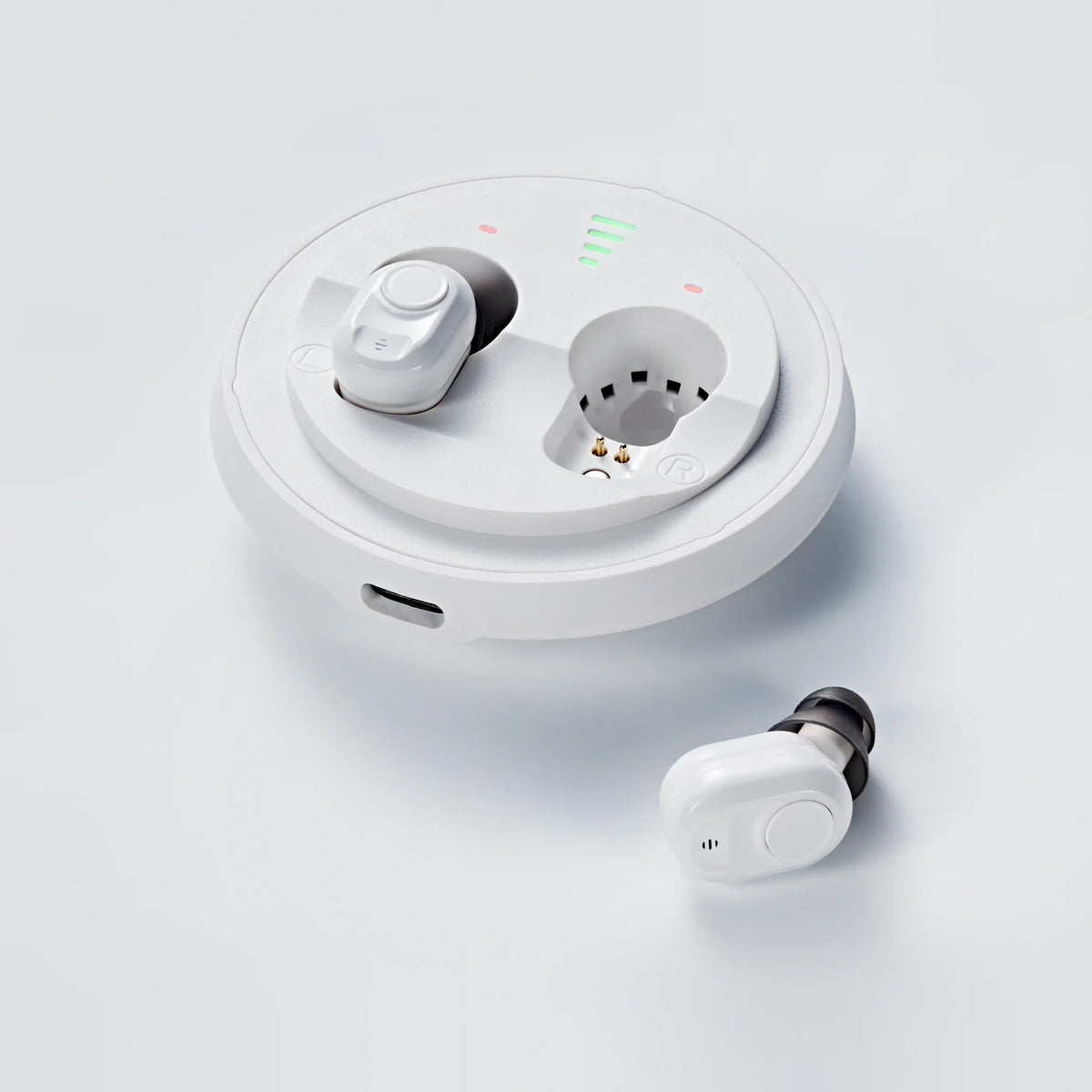
HearOne has eight processing channels; HearDuo has four. Those specifications describe differences in sound processing. They do not mean HearOne provides twice the hearing benefit, or that HearDuo will meet every person’s needs.
Consider the complete choice: how you want to wear the device, how easily you can operate it, how it feels in your ear, the sound settings and the support available. No study reviewed here directly compares HearOne with HearDuo.
Compare HearOne and HearDuo to see their styles, controls and specifications together. You can also Explore HearOne hearing aids or Explore HearDuo hearing aids.
Three useful questions before you choose
- What can this device adjust? Ask what its channel and band specifications actually describe.
- How will my settings be selected? Understand the setup process and the help available.
- What will be checked—and what happens next? Ask what the measurement tells you, what it cannot tell you and how it informs further adjustment.
Affordable hearing aids should still come with clear explanations. If you are unsure where to start, Get help choosing and setting up your hearing aids.
Affordable hearing aids. Personalized sound. Patented verification.
Over-the-counter hearing aids can offer a more affordable, accessible way to get hearing support. Adults 18 and older with perceived mild-to-moderate hearing loss can buy them without a prescription, in a store or online. The OTC category was created to broaden access and encourage lower-cost options. Read the FDA’s guide to OTC hearing aids.
OIDO is the only OTC hearing-aid brand with its own patented fit-verification process—checking what you hear with your hearing aids on and using your responses to guide further fine-tuning.
Explore Our Technology, follow How It Works, or read the science behind OIDO’s patent.
Built from Jason Anderson’s own hearing experience
For OIDO founder Jason Anderson, sound has always been personal. A violinist who discovered hearing loss while playing at Yale, Jason experienced the cost and frustration of finding hearing support firsthand. He wanted a clearer answer to a simple question: how were changes to his hearing aids affecting what he could hear?
That experience helped shape OIDO’s focus on affordable hearing aids, accessible support and a process that checks the wearer’s response. Meet Jason and explore OIDO’s story, or read Jason’s account of why he built OIDO.
Visit OIDO in Vancouver, Washington
Prefer to start with a conversation? Visit OIDO Hearing inside Walmart in Vancouver, WA, for a free hearing screening and help exploring your options. Our team can walk you through HearOne and HearDuo, answer questions about setup and help you understand the next step.
Visit our Vancouver, WA hearing center →
Whether you begin online or in person, look beyond the channel count. Choose hearing support with a clear setup process, understandable checks and help when you need it.
Sources and further reading
These studies examine different technologies, tests and populations. None establishes a universal ideal channel count or directly validates OIDO’s verification method.
- Leavitt & Flexer (2012). The Importance of Audibility in Successful Amplification of Hearing Loss.
- Yund & Buckles (1995). Multichannel compression hearing aids: effect of number of channels on speech discrimination in noise.
- Salorio-Corbetto et al. (2020). Effect of the number of amplitude-compression channels and compression speed on speech recognition by listeners with mild to moderate sensorineural hearing loss.
- Abrams et al. (2012). Initial-fit approach versus verified prescription: comparing self-perceived hearing aid benefit.
- Almufarrij et al. (2023). Listening Preferences of New Adult Hearing Aid Users: A Registered, Double-Blind, Randomized, Mixed-Methods Clinical Trial of Initial Versus Real-Ear Fit.
- Jürgensen, Denk & Husstedt (2024). Visualization and analysis of multi-channel dynamic range compression in hearing aids.

Leave a comment
This site is protected by hCaptcha and the hCaptcha Privacy Policy and Terms of Service apply.