

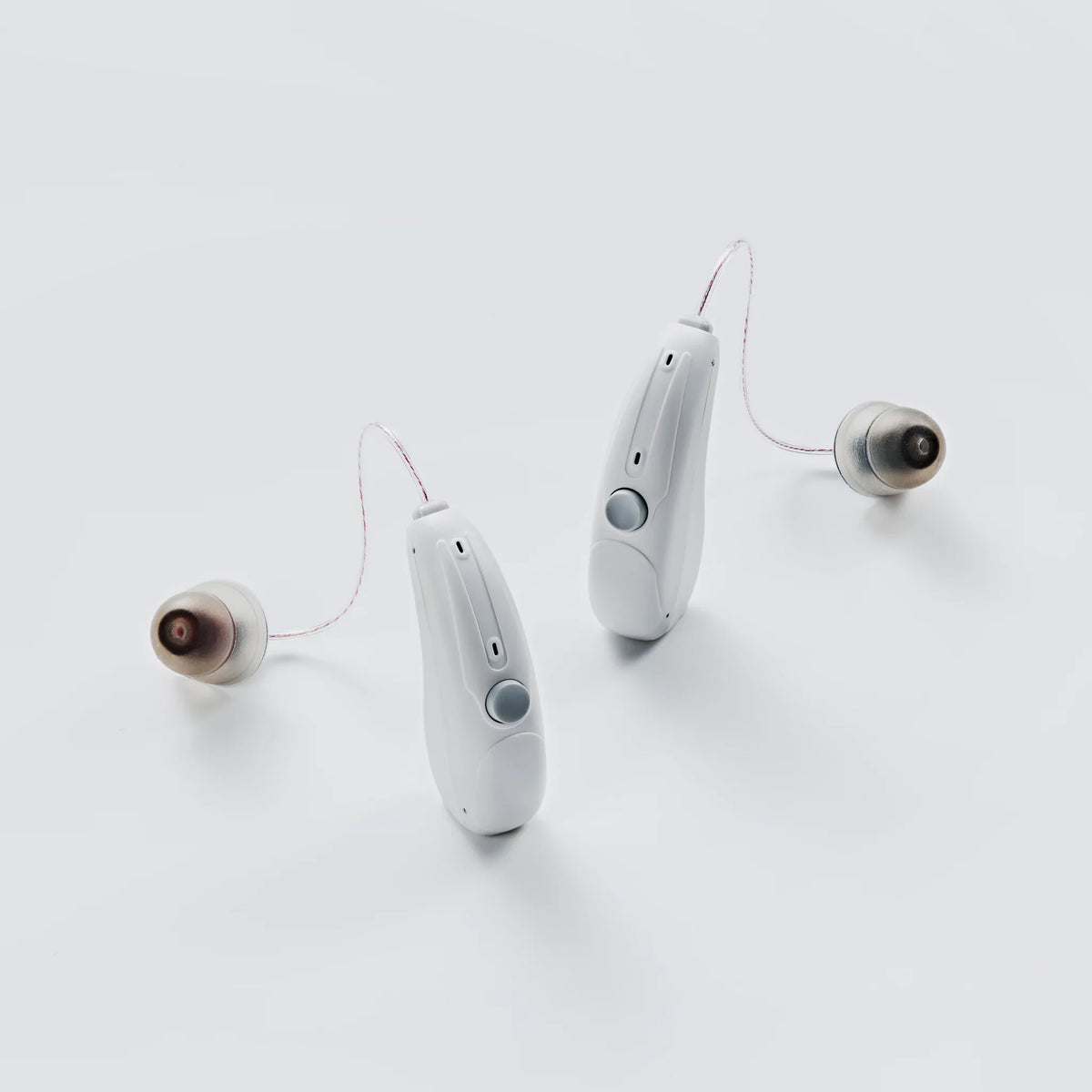
OIDO HearOne hearing aids, with thin receiver wires and soft ear tips.
The kettle clicks off just as someone across the kitchen asks a question. You hear their voice, but miss a few words.
A hearing aid picks up sound, adjusts it according to its settings, and plays the adjusted sound into your ear. The goal is to make sounds you struggle to hear more accessible.
Here is what happens inside that small device—and why getting the settings right matters.
From the room to your ear
1. A microphone picks up sound. A voice, a running tap, the scrape of a chair: the microphone receives the sounds around you and converts them into an electrical signal.
2. A processor adjusts the sound. In a digital hearing aid, the signal becomes information a chip can process. Different pitches can receive different amounts of amplification. Higher-pitched sounds may need more help than lower-pitched ones, depending on your hearing.
3. A tiny speaker delivers the result. The speaker is also called a receiver. It sends the adjusted sound toward your ear canal. The ear and brain still do the work of hearing and making sense of what you hear.

Why turning everything up is not the whole answer
Imagine adjusting a photograph. Increasing the brightness everywhere might reveal a dark corner while washing out the window. Adjusting different areas separately can give you a more useful result.
Hearing-aid settings also do more than raise the overall volume. Many devices use compression to give softer sounds more amplification than louder sounds. Settings can also vary by pitch.
The aim is to help make quiet sounds audible while keeping louder sounds comfortable. Learn about hearing-aid fitting and sound adjustments.

What happens in a noisy room?
Depending on the model, directional microphones can emphasize sound from a particular direction, while noise-reduction features adjust sounds identified as noise.
Those features have limits. Two people talking at once can still be difficult to separate, especially when their voices come from the same direction. Hearing aids cannot remove every distraction or guarantee that you will understand every word.
For a closer look at that everyday challenge, read why speech can be difficult to understand in background noise.
What does getting a hearing aid “fitted” mean?
Fitting includes physical comfort and sound settings. Two people can wear the same model and need different adjustments.
Verification checks the fitting against defined targets. One professional method is real-ear measurement: a small probe tube measures the sound delivered in the ear while the hearing aid is working. Those measurements help guide adjustments. Read about fitting and verification.
Describe the situations you want to improve, too. “I miss words when the kitchen fan is running” gives someone helping you more to work with than “something sounds wrong.”

How OIDO approaches setup and verification
With standard HearOne and HearDuo models, you respond to tones played through the hearing aids in the app. Your responses help customize the sound settings. See how OIDO hearing-aid setup works.
OIDO’s patented sound verification lets you check your hearing-aid settings yourself and guides further adjustments. You respond to a separate verification test while wearing the hearing aids. The results help guide adjustments to the sound settings.
That extra verification step is available through OIDO’s in-store offering and is planned for upcoming Pro models; it is not included in the standard at-home setup for HearOne and HearDuo. The method checks sound detection and is different from the probe-tube measurements described above.
Explore OIDO’s sound-verification technology, or read the story behind OIDO’s calibration patent.
Will hearing sound familiar straight away?
Some sounds may seem unfamiliar at first. The rustle of clothing or the hum of a refrigerator may become more noticeable.
Getting used to hearing aids can take time. Tell your provider if sound is uncomfortable or a device is not helping in the situations that matter to you. Hearing aids do not restore natural hearing or eliminate every listening difficulty. Explore hearing-aid benefits and limitations.
Where should you start?
Write down one moment you would like to make easier: a conversation in the car, a family dinner, or a phone call.
You can also take OIDO’s free hearing screener as a starting point. Your results are a starting point for understanding your hearing, not a diagnosis or a substitute for a professional hearing evaluation.
Our guide to how hearing tests work explains what an evaluation can involve.
If your hearing drops suddenly, seek medical attention immediately. Do not wait for an online screening or a hearing-aid adjustment. Read guidance on sudden hearing loss.
Making hearing care more accessible
For adults ages 18 and older with perceived mild to moderate hearing loss, Over the Counter (OTC) hearing aids are available without a prescription. OTC hearing aids can be a more affordable alternative to prescription hearing aids, making hearing care easier to access. When comparing options, consider the total price and the support and services included. Learn who OTC hearing aids are for.
OIDO founder Jason Anderson knows the frustration of hearing someone’s voice without catching the words. His personal experience helped shape OIDO’s approach. Read Jason Anderson’s story.
To explore affordable OTC hearing aids with in-person help, visit OIDO Hearing inside Walmart in Vancouver, WA. Prefer to begin at home? Take the OIDO hearing screener.


Leave a comment
This site is protected by hCaptcha and the hCaptcha Privacy Policy and Terms of Service apply.