

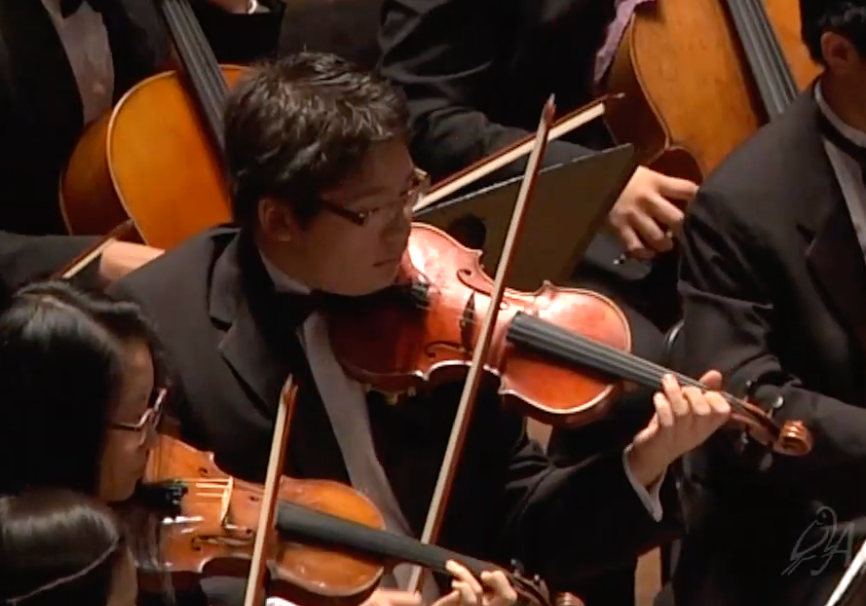
Hearing loss found me at Yale, in the middle of a life built on sound. Here's how it became a patent, a hearing company, and the first store in my hometown.
By Jason Anderson, founder of OIDO.
Quick facts
-
Founder: Jason Anderson founded OIDO. He is a violinist from Vancouver, Washington, who lives with mild hearing loss.
-
Company: OIDO is a hearing health company. It sells over-the-counter hearing aids, HearDuo and HearOne, and offers a free hearing screener.
-
Invention: Jason is the inventor on U.S. Patent 12,627,938, "Calibration of Wearable Sound-Emitting Devices," granted May 12, 2026. It covers a two-step way to set a hearing aid and then check it again.
-
First store: OIDO opens on Wednesday, November 10, 2026, inside Walmart Supercenter #2550 at 221 NE 104th Ave, Vancouver, WA 98664. Find OIDO Vancouver store hours and directions.
-
Who it's for: Over-the-counter hearing aids are for adults 18 and older with perceived mild to moderate hearing loss.
A life built on sound
Sound has been my first language for as long as I can remember. The violin came first, and with it a seat in the Portland Youth Philharmonic. Later came DJ sets and music festivals, where a whole crowd hears the same song at the same moment.
For the science behind those experiences, explore how sound travels from vibration to meaning and how frequency shapes the pitch of music and speech.
Science ran alongside the music. In high school, I was a national semifinalist in the Intel Science Talent Search.
At Yale, sentences arrived with pieces missing
At Yale, conversations started arriving with pieces missing. A voice would come through clearly enough to tell me someone was talking, while some of the words slipped past. Asking people to repeat themselves became a habit.
Soft, high-pitched sounds like s, t, and th are often the first to fade. A sentence can sound whole and still lose its meaning. Filling the gaps took effort, and the effort cost me what came next.
Researchers have measured that cost. In a 2005 study, older adults with mild to moderate hearing loss remembered fewer spoken words than peers with good hearing, even words they had heard clearly enough to repeat. The researchers concluded that the extra effort of hearing uses resources the brain would otherwise spend storing speech in memory.
The conversation you strain to hear is the one you're less likely to remember.
What hearing has to do with the brain
Hearing brings us the people we can't see: a laugh from the next room, a voice on the phone saying the plane just landed. It matters for the brain, too.
The 2024 Lancet Commission on dementia identified hearing loss as one of the largest modifiable risk factors for dementia, meaning a factor people may be able to change. Researchers are still testing whether treating hearing loss lowers that risk. These findings describe large groups of people, and they don't predict any one person's future.
For me, all of it adds up to one habit: caring for hearing early, the way we already care for our teeth, our skin, and our sleep.
If you're curious about the research, we've taken a closer look at the connection between hearing loss and cognitive decline, including what scientists know and what they're still trying to figure out.
Why hearing care costs so much time and money
Getting help took longer than I expected. The hearing aids I tried came with hard-to-use apps and unintuitive controls, and every adjustment depended on another appointment, in person or by video. My provider could change the settings, but there was no direct way to know what those changes did to what I heard.
One question kept coming back: why does hearing care cost so much time and money?
About 28.8 million U.S. adults could benefit from hearing aids, and only about 1 in 4 of those adults has used one. Among adults 20 to 69, it's about 1 in 6.
OIDO is how I'm answering that question. We want to make hearing easier to understand, protect, and support, with products people want to wear, guided technology, useful education, and human help.
So I patented a way to tune hearing aids
On October 17, 2022, an FDA rule took effect that created a new category: over-the-counter hearing aids. Adults 18 and older with perceived mild to moderate hearing loss can now buy them in stores and online, without a medical exam, a prescription, or a fitting adjustment by an audiologist.
That raised the question I had been living with: when you set up hearing aids yourself, how do you know they're set right?
Seven weeks after the rule took effect, I filed the first application for my answer. It became U.S. Patent 12,627,938, granted on May 12, 2026, and it describes a check in two steps:
-
Set it by ear. Tones play through the hearing aid, and your answers adjust its settings.
-
Check it again. With your hearing aids on, a calibrated sound source, such as calibrated headphones or speakers, plays test tones. The settings are refined from what you can actually detect.
The second step is the part I care about most. It's a second listen with your hearing aids in, so the settings follow what you hear.
The check has limits worth knowing. It tests whether you detect soft tones with your hearing aids on. It doesn't measure how well you follow speech in noise, and it doesn't replace a professional hearing evaluation.
Today's standard OIDO pairs don't include the second check. We plan to offer it with our upcoming Pro models.
For anyone interested in the technical details, I've written more about the science behind personalized hearing in a separate article.
Why OIDO starts at Walmart, in my hometown
Vancouver, Washington, is home. It's where I grew up and graduated from Columbia River High School.
On Tuesday, November 10, 2026, we opened OIDO's first store in Vancouver, Washington, inside Walmart Supercenter #2550. Walmart is where people pick up groceries, prescriptions, and new glasses, so hearing care can join an errand they're already running. Hearing shouldn't cost so much, in money or in time.
At the store, you can take our free hearing screener. It estimates the range of your hearing and recommends an OIDO product based on your results. It's a starting point for understanding your hearing and doesn't diagnose hearing loss.
Grand opening offer, through November 30, 2026
Take the free hearing screener at our Walmart store and get $100 off a pair of OIDO hearing aids. That brings HearDuo to $399 a pair and HearOne to $499 a pair.
Where: OIDO, inside Walmart Supercenter #2550, 221 NE 104th Ave, Vancouver, WA 98664.
Terms: $100 off one pair of OIDO hearing aids after the free screener, through November 30, 2026. Over-the-counter hearing aids are for adults 18 and older with perceived mild to moderate hearing loss.
Hear for a good time and a long time
That line is my favorite pun, and it holds the whole idea. A good time is catching the punchline at a loud dinner and every note at a show. A long time is more dinners, more music, and more conversations worth catching.
Take the free screener at our store or at oidohear.com. If you're nearby, come see us at OIDO Hearing in Vancouver, Washington. If you'd rather start from home, you can book a one-on-one support meeting with our team.
Follow OIDO Hearing on Instagram for hearing health, products, and updates from our Vancouver store. I also share the behind-the-scenes journey of building OIDO on @oido.json.
Nice to hear you!
Frequently asked questions
Who founded OIDO?
Jason Anderson founded OIDO. He is a violinist from Vancouver, Washington, who lives with mild hearing loss. He is also the inventor on U.S. Patent 12,627,938, granted May 12, 2026, which covers a two-step way to set a hearing aid and then check it again.
What is OIDO?
OIDO is a hearing health company that sells over-the-counter hearing aids and offers a free hearing screener. HearDuo is $499 a pair, and HearOne is $599 a pair. The screener estimates the range of your hearing and recommends an OIDO product based on your results.
Where can I buy OIDO hearing aids?
OIDO hearing aids are sold online at oidohear.com. OIDO's first store opens on November 10, 2026, inside Walmart Supercenter #2550 at 221 NE 104th Ave in Vancouver, Washington.
What does OIDO's patent cover?
U.S. Patent 12,627,938, "Calibration of Wearable Sound-Emitting Devices," covers a two-step hearing aid check. First, tones play through the hearing aid, and its settings change based on the listener's answers. Then a calibrated sound source, such as calibrated headphones or speakers, checks again and refines the settings. OIDO plans to offer the second check with its upcoming Pro models.
Do I need to see a hearing professional first?
Not necessarily: in the U.S., adults 18 and older with perceived mild to moderate hearing loss can buy OTC hearing aids without a prescription or a hearing exam. A hearing professional can still help you understand your hearing and explore your options.
If you have ear pain or drainage, dizziness, hearing that changes suddenly or fluctuates, or hearing loss or ringing mainly in one ear, seek medical care before choosing a hearing aid. Sudden hearing loss needs urgent medical attention. If you suspect severe hearing loss, start with a hearing professional.
Is hearing loss linked to dementia?
Research links hearing loss with dementia risk across large groups of people. The 2024 Lancet Commission on dementia identified hearing loss as one of the largest modifiable risk factors for dementia. These findings don't predict any one person's risk, and researchers are still testing whether treating hearing loss lowers it. OIDO's screener doesn't measure memory or thinking.
Sources
-
Livingston G, et al. Dementia prevention, intervention, and care: 2024 report of the Lancet standing Commission. The Lancet. 2024;404(10452):572-628.
-
McCoy SL, Tun PA, Cox LC, Colangelo M, Stewart RA, Wingfield A. Hearing loss and perceptual effort: downstream effects on older adults' memory for speech. Quarterly Journal of Experimental Psychology. 2005;58(1):22-33.
-
National Institute on Deafness and Other Communication Disorders. Hearing Loss and Hearing Aid Use.
-
U.S. Food and Drug Administration. OTC Hearing Aids: What You Should Know.
-
Anderson J. Calibration of wearable sound-emitting devices. U.S. Patent 12,627,938 B2, granted May 12, 2026. Assignee: Oido Inc.



Leave a comment
This site is protected by hCaptcha and the hCaptcha Privacy Policy and Terms of Service apply.