

Last updated: November 22, 2026
An audiogram can look like a page of mysterious numbers, circles and crosses. It is simply a map of the softest tones you could hear during a hearing test, at different pitches.
Read it in three steps: look across for pitch, look down for the level needed, then compare the marks with the speech sounds you use every day.
1. Left to right: low pitch to high pitch
The horizontal axis shows frequency in hertz (Hz). Low pitches sit on the left; high pitches sit on the right. A low hum belongs toward the left side of the pitch range. The hiss in “s” belongs toward the right. Read our guide to frequencies and familiar sounds for more examples.
Common test frequencies include 250, 500, 1,000, 2,000, 4,000 and 8,000 Hz. The numbers usually double between equally spaced major columns. These are test tones, not recordings of words.
2. Top to bottom: how much level was needed
The vertical axis shows hearing level in decibels, or dB HL. Softer test levels are near the top. Farther down means the tone needed more level before you detected it. A mark at 50 dB HL therefore represents a higher hearing threshold than one at 10 dB HL.

In this invented example, the threshold is 15 dB HL at 500 Hz and 50 dB HL at 4,000 Hz. The person needed a higher level for the higher-pitched tone. This is not a real person’s result.
Zero dB HL is a standardized reference for hearing thresholds, not silence. It is different from dBA on a sound-level meter. An outdoor noise reading cannot simply be placed at the same number on this chart.
3. Find the sounds inside familiar words
The shaded area below is often called the speech banana because of its curved shape. It illustrates where features of conversational speech are often shown on an audiogram. Try saying “mom,” “moon,” “father,” “see,” “shoe” and “sun.” Notice how a low hum and a high hiss feel different.

- “m” in “mom” and “oo” in “moon”: useful examples of lower-frequency speech energy.
- “ah” in “father” and “ee” in “see”: vowel sounds with several frequency components; the map shows illustrative landmarks.
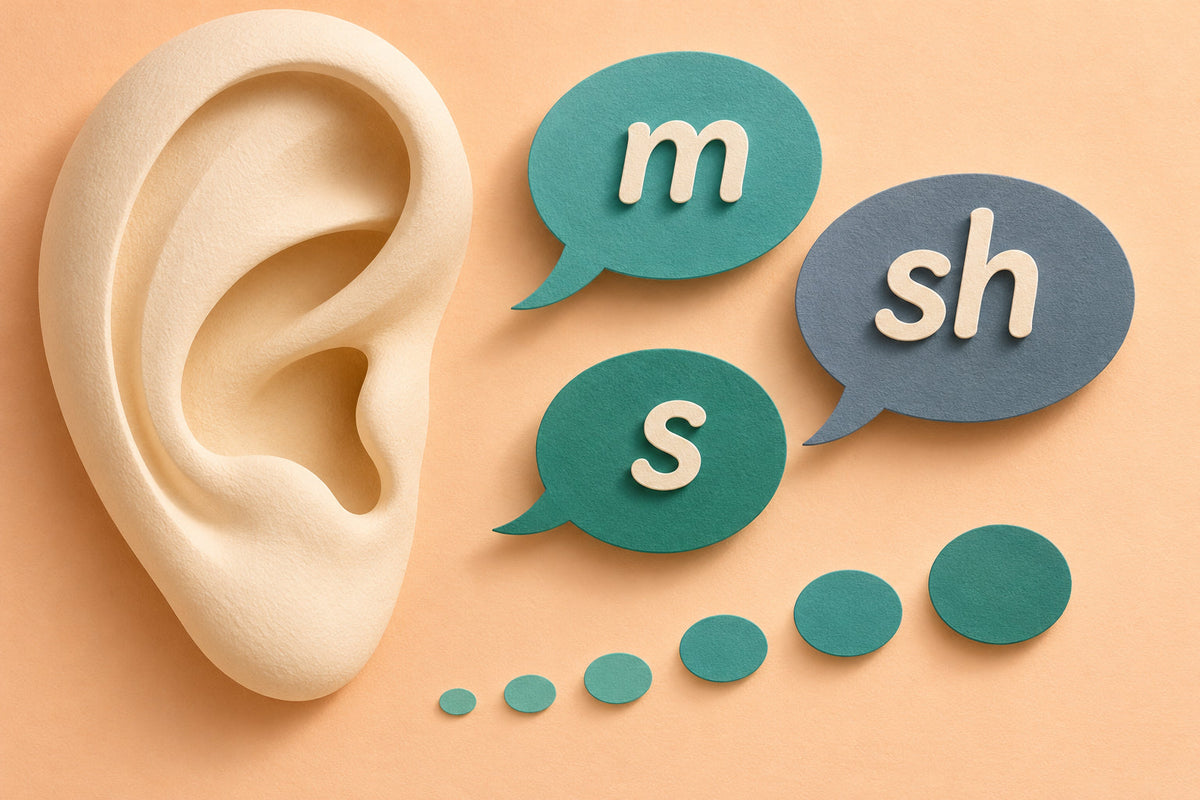
- “sh” in “shoe” and “s” in “sun”: consonant detail extending into higher frequencies.
These are not exact coordinates for whole words. The speaker, language, distance and vocal effort all change the sound. Bird calls, music and engines also occupy ranges rather than single dots; the frequency guide’s sound examples connects those to the horizontal axis.
Why a voice can be audible while words are unclear
At a given frequency, sounds plotted above a person’s threshold are softer than the level they detected in the test. Sounds below it are stronger. If a threshold line drops beneath parts of the speech region, some of those details may be difficult to hear.
For example, you might hear the body of a voice but miss the final “s” that distinguishes “cats” from “cat.” The map helps explain that experience. It cannot predict exactly which words you will understand, especially in background noise.
What do the circles and crosses mean?
On a typical clinical audiogram, red O symbols represent the right ear and blue X symbols represent the left ear for tones delivered through headphones or earphones without masking. Other symbols may show bone-conduction testing, masking or no response. Use your chart’s legend and ask your hearing professional to explain unfamiliar marks. The example above uses a simplified single line.
What does this mean for hearing aids?
The shape helps identify which frequency ranges need support. It does not, by itself, tell you how well you understand speech, how you cope in noise or which hearing aid will suit you. A full evaluation combines the chart with other tests and your listening goals.
Continue with decibels and perceived loudness, or read Jason Anderson’s hearing experience and the story of OIDO Hearing.
Sources and further reading
Curious about your own hearing?
Take the next step with OIDO’s free online hearing screener. It is a screening, not a diagnosis or a substitute for a professional hearing evaluation.
Affordable hearing aids in Vancouver, WA
Over the Counter (OTC) hearing aids can be a lower-cost, more affordable alternative to prescription hearing aids for adults 18 and older with perceived mild to moderate hearing loss. Prices, features and included services vary, so compare the full cost and the support you need.
At OIDO Hearing inside Walmart in Vancouver, WA, you can explore hearing aids, get a free Quick Hearing Check and receive help with setup. Visit our hearing center at 221E NE 104th Ave, or explore affordable hearing aids at our Vancouver location.
The Quick Hearing Check is a screening, not a medical diagnosis. OTC hearing aids are not intended for children or people with severe or profound hearing loss. Read the FDA guide to choosing OTC hearing aids for more information.



Leave a comment
This site is protected by hCaptcha and the hCaptcha Privacy Policy and Terms of Service apply.