
Last updated: November 22, 2026
Does 80 decibels sound twice as loud as 40? No—and that is why decibels can be confusing. The number measures sound on a scale that multiplies rather than adds.
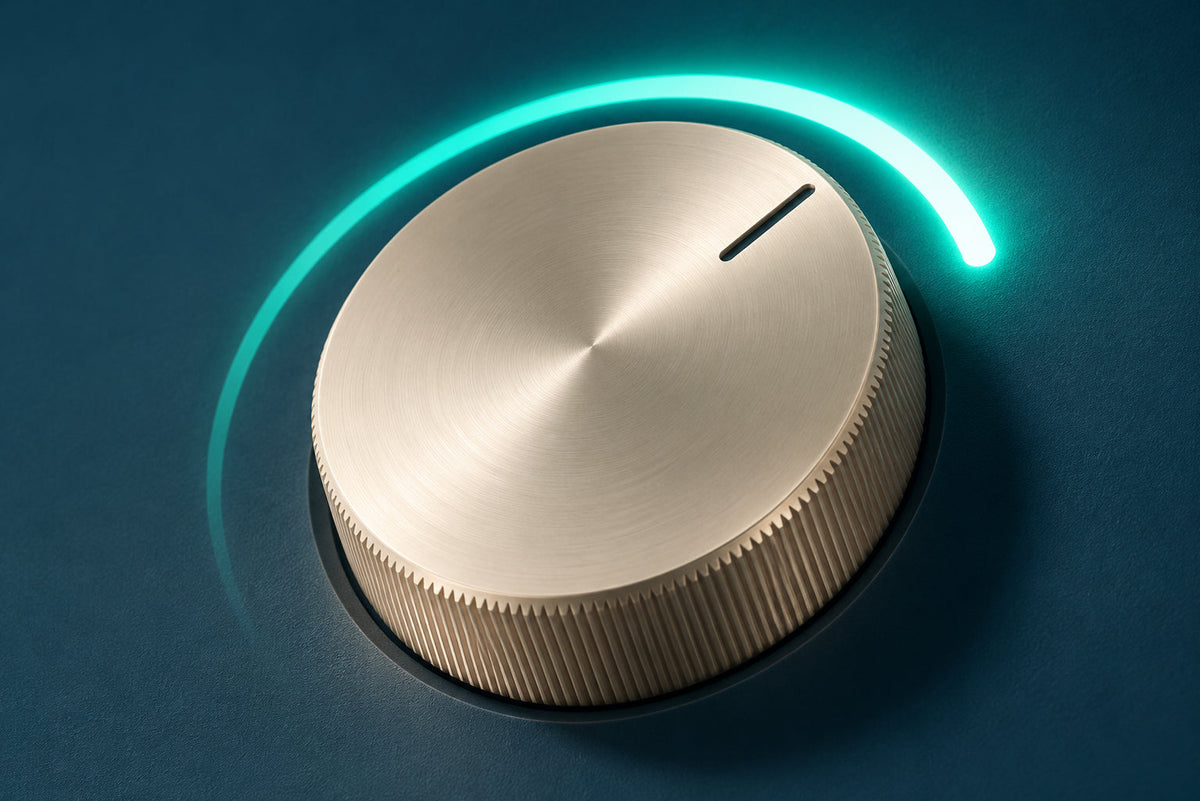
The useful starting point: turning the same sound up by 10 decibels usually makes it seem about twice as loud, even though its physical intensity becomes 10 times greater. Here is how to connect that idea to everyday listening.
1. What does a decibel tell you?
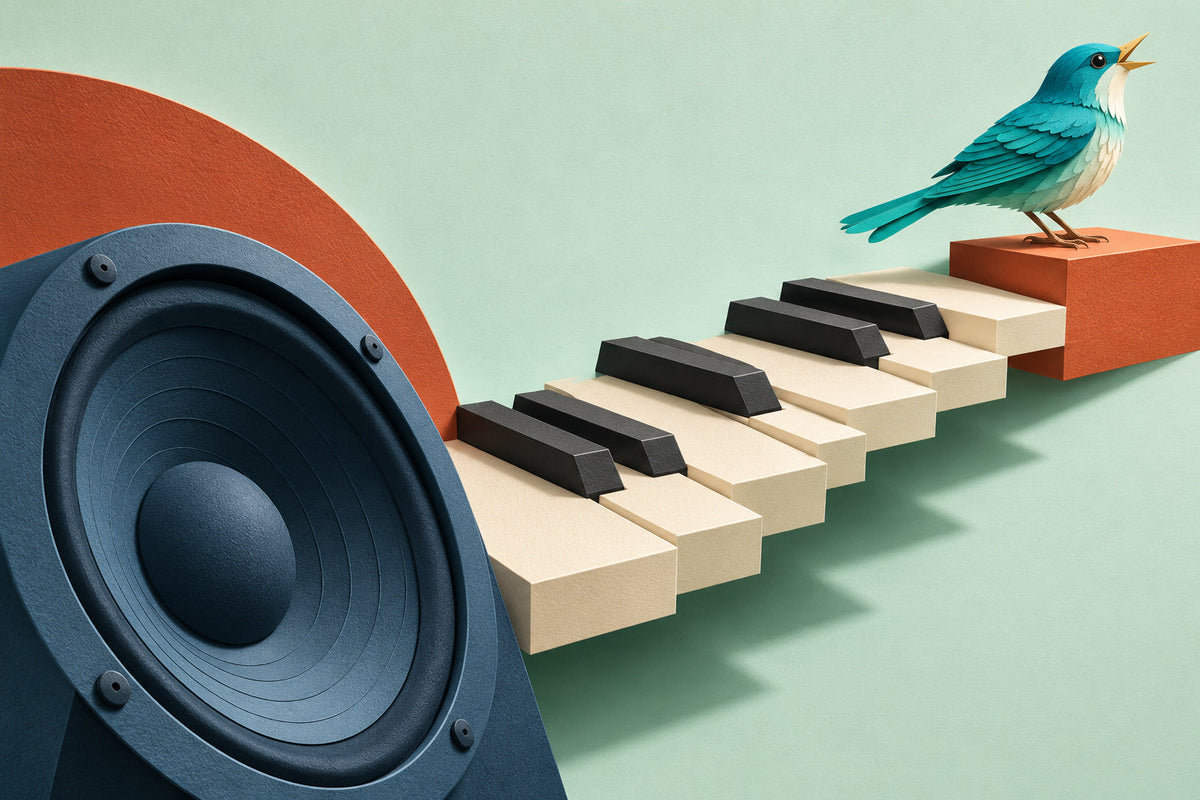
A decibel, abbreviated dB, expresses a level relative to a reference. When we use decibels to describe sound around us, a higher reading means a greater sound level. It does not tell you whether the sound is low-pitched, like a bass note, or high-pitched, like a whistle. That is frequency—the pitch of a sound.
For context, a whisper may be around 30 dBA, conversation around 60–70 dBA, and a loud concert around 94–110 dBA. These are examples, not fixed ratings: distance, the room and the sound source matter. The “A” means the measurement is adjusted for the ear’s different sensitivity to different frequencies.
Common sounds on the decibel scale

2. What changes when the number goes up?
Imagine playing the same recording at 50, 60 and 70 dB at your seat. Each 10 dB step multiplies its intensity by ten. That makes 70 dB 100 times the intensity of 50 dB: ten times ten.
But your experience does not grow at the same rate. As a rule of thumb, 60 dB may seem about twice as loud as 50 dB, and 70 dB about four times as loud as 50 dB. Turning down by 10 dB reverses that estimate: roughly half as loud.

3. Keep these three comparisons in mind
- +3 dB: about twice the intensity, but only a modest change in perceived loudness.
- +10 dB: ten times the intensity; roughly twice as loud.
- +20 dB: one hundred times the intensity; roughly four times as loud.

The intensity ratios come from the mathematics of the decibel scale. The loudness estimates describe human perception and vary with pitch, starting level, duration and hearing. They are not a precise prediction of how a particular person will hear a sound.
4. Why “double” can mean different things
Intensity is the sound energy flowing through an area each second. Perceived loudness is how loud that sound feels to you. Doubling the first does not double the second.
You may also hear that +6 dB means “double.” That refers to sound-pressure amplitude—the size of the air-pressure variation—under comparable conditions. For everyday listening, remember the approximately +10 dB rule for twice the perceived loudness. Always check what is being doubled.
5. Are hearing-test decibels the same?
Not directly. The letters after dB tell you what the number means:
- dB SPL: sound pressure level compared with a standard reference pressure.
- dBA: a frequency-weighted sound-level measurement, commonly used for environmental noise.
- dB HL: hearing level on an audiogram, calibrated against reference hearing thresholds at each frequency.
A result of 40 dB HL is not a room-volume reading of 40 dBA. Zero on either reference scale does not mean “no sound.” Our guide to reading an audiogram and its hearing-level scale makes that distinction visual.
What are the levels of hearing loss in decibels?
Hearing professionals use dB HL to describe how much level a person needs to detect a test tone. One commonly used ASHA classification of hearing-loss levels uses these ranges:
| Hearing category | Hearing threshold range |
|---|---|
| Normal range | −10 to 15 dB HL |
| Slight | 16–25 dB HL |
| Mild | 26–40 dB HL |
| Moderate | 41–55 dB HL |
| Moderately severe | 56–70 dB HL |
| Severe | 71–90 dB HL |
| Profound | 91 dB HL or greater |
The categories are neighboring ranges, not equally spaced stages. For example, a threshold of 30 dB HL falls in the mild range; 50 dB HL falls in the moderate range—a 20 dB difference. Clinical systems can use different boundaries, and hearing can fall into different categories at different frequencies.
That 20 dB difference describes the level needed to detect a tone. It does not mean someone has a fixed percentage of hearing remaining or that every sound feels four times quieter. The approximate loudness comparisons earlier in this article do not convert hearing-loss categories into a personal volume formula.
6. What this means for hearing aids and everyday listening
A phone at 50% volume is not necessarily half as loud. The recording, headphones, fit and device all affect what reaches your ears. And a sound that feels only a little louder can carry substantially more energy. Hearing risk depends on both level and exposure time; move away, lower the volume or use suitable hearing protection around loud noise. For practical ways to manage everyday exposure, read How Loud Is Too Loud? A Guide to Protecting Your Hearing.
Hearing aids also do more than turn up every sound equally. Different pitches may need different amounts of amplification. Start with how sound reaches your ears and brain, then explore why personalized hearing goes beyond amplification.
Over the Counter (OTC) hearing aids are for adults 18 and older with perceived mild to moderate hearing loss. A category on a chart alone does not establish whether a particular device will meet your needs. More significant hearing loss calls for professional evaluation and discussion of appropriate hearing-aid options. The FDA guide to OTC hearing aids explains the intended users and when to seek professional care.
For the personal experience behind OIDO Hearing, read why Jason Anderson founded OIDO Hearing.
Sources and further reading
- NIDCD: how sound is measured
- NIDCD: everyday sound levels and noise-induced hearing loss
- UNSW: decibels, pressure and intensity
Affordable hearing aids in Vancouver, WA
OTC hearing aids can be a lower-cost, more affordable alternative to prescription hearing aids for adults 18 and older with perceived mild to moderate hearing loss. Prices, features and included services vary, so compare the full cost and the support you need.
At OIDO Hearing inside Walmart in Vancouver, WA, you can explore hearing aids, get a free Quick Hearing Check and receive help with setup. Visit our hearing center at 221E NE 104th Ave, or explore affordable hearing aids at our Vancouver location.
The Quick Hearing Check is a screening, not a medical diagnosis. OTC hearing aids are not intended for children or people with severe or profound hearing loss. Read the FDA guide to choosing OTC hearing aids for more information.

Leave a comment
This site is protected by hCaptcha and the hCaptcha Privacy Policy and Terms of Service apply.